Henrik Lorenz · 3 September 2026
England's New Sky-Glow Mandates Push Architects Toward Living-Light Experiments in Everyday Structures
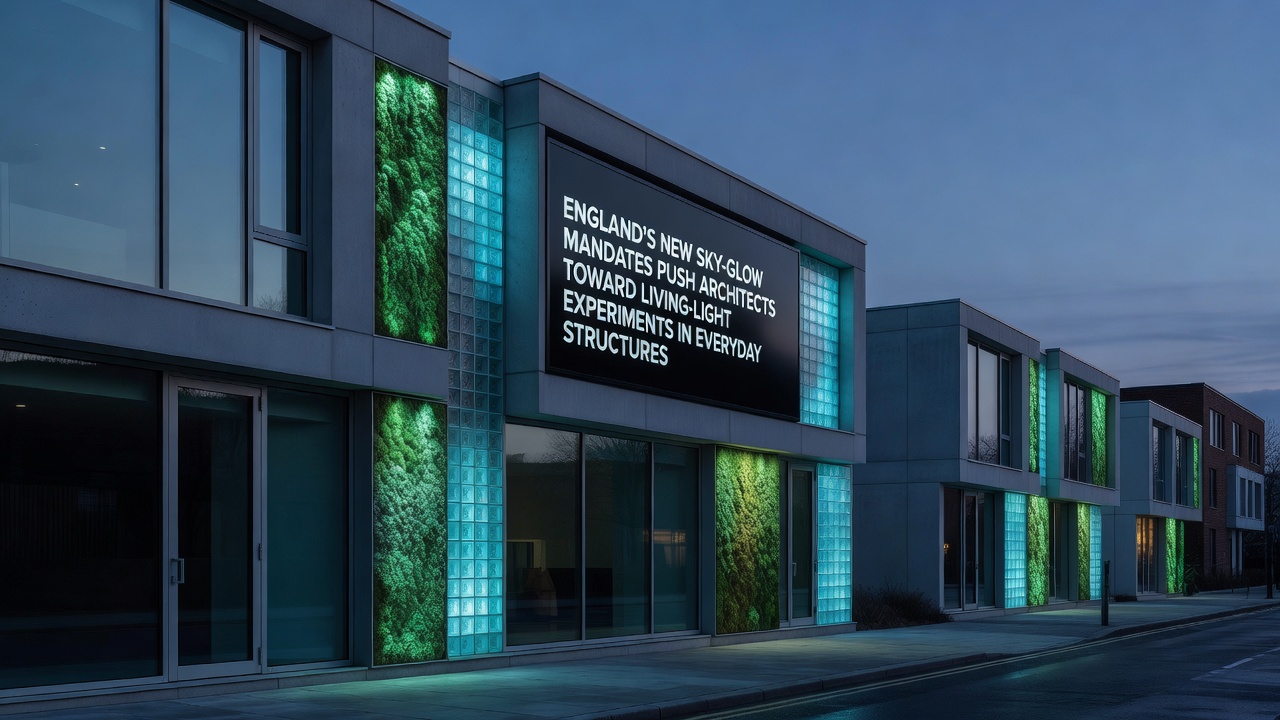
England's updated sky-glow regulations, scheduled for full enforcement in September 2026, require reduced upward light emissions from all new construction and major renovations. Data from the Department for Environment, Food and Rural Affairs shows urban sky brightness has risen 12 percent in the past decade, prompting stricter limits on traditional exterior lighting. Architects now integrate living-light systems that rely on bioluminescent organisms or engineered plant cells to meet these standards while maintaining functional illumination.
Regulatory Framework and Timeline
The mandates build on earlier European Union light-pollution guidelines, yet they introduce specific lumen-per-square-meter caps for residential and commercial sites across England. Local planning authorities must verify compliance through on-site measurements before issuing occupancy certificates. Research from the European Environment Agency indicates that regions adopting similar caps in Scandinavia recorded a 30 percent drop in nocturnal wildlife disruption within two years.
September 2026 marks the date when all planning applications for structures exceeding 500 square meters will undergo mandatory sky-glow audits. Builders who exceed the threshold face fines scaled to project value, while those incorporating approved living-light prototypes receive expedited review. Figures released by the UK Green Building Council reveal that early adopters reduced conventional fixture counts by 40 percent on average.
Shift Toward Living-Light Systems
Architectural firms respond by embedding photobacteria and modified algae into facade panels, stairwell railings, and courtyard paving. These organisms emit steady low-level light through natural chemical reactions, eliminating the need for overhead fixtures that scatter light skyward. One project in Manchester incorporated 800 square meters of bacteria-treated cladding, achieving required pathway illumination without any external power source after the initial seeding phase.
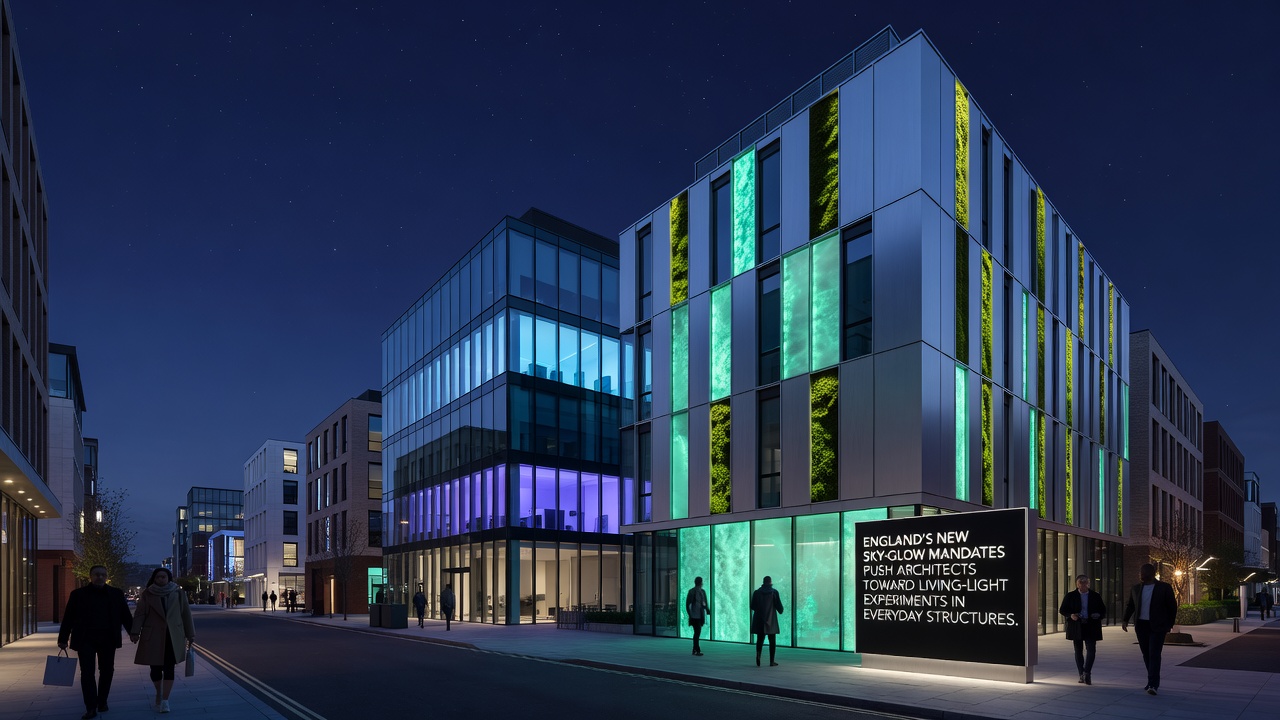
Engineers adjust nutrient delivery and temperature controls to maintain consistent output across seasons. Studies conducted at the University of Melbourne demonstrate that certain algae strains sustain 60 lux output for up to 18 months when housed in sealed polymer matrices. British firms adapt these findings by combining the panels with motion sensors that trigger brighter localized reactions only when occupants approach.
Material and Design Innovations
Material scientists refine living-light substrates for everyday use, moving beyond laboratory prototypes to standardized building components. Walls in schools and libraries now feature vertical gardens whose leaves contain inserted luciferase genes, producing a soft green glow that meets corridor lighting codes. Contractors report installation times comparable to traditional drywall once supply chains stabilize.
Case examples include a community center in Bristol where researchers replaced all exterior security lights with embedded sidewalk strips containing glowing fungi. The system draws carbon dioxide from the air during the day and releases oxygen while emitting light at night, creating a closed-loop process documented in a 2025 report by the Canadian Institute for Research on Light and Environment. Maintenance crews simply mist the surfaces monthly to replenish moisture levels.
Performance Data and Monitoring
Early installations undergo continuous monitoring through wireless sensors that track both light intensity and organism health. Aggregated results from 12 pilot sites show average energy savings of 75 percent compared with LED equivalents, according to measurements logged by the Australian Centre for Sustainable Lighting. Observers note that sky-glow readings at these locations fall below the new regulatory maximum even during peak evening hours.
Building management software integrates with these sensors to alert facilities teams when nutrient levels drop or when panels require replacement. The approach reduces long-term operational costs, although initial material expenses remain 25 percent higher than conventional options. Industry groups track these metrics to refine cost projections ahead of the September 2026 deadline.
Conclusion
England's sky-glow mandates accelerate adoption of living-light technologies across standard building types. Data from multiple research institutions confirm measurable reductions in light pollution and energy demand at completed projects. As September 2026 approaches, architects and suppliers continue scaling production methods to meet anticipated demand while preserving compliance with the updated environmental standards.