Avery Lang · 1 October 2026
England Tests Sensor-Based Lighting Adjustments in Suburbs to Safeguard Bat Habitats Under Stricter Glow Limits
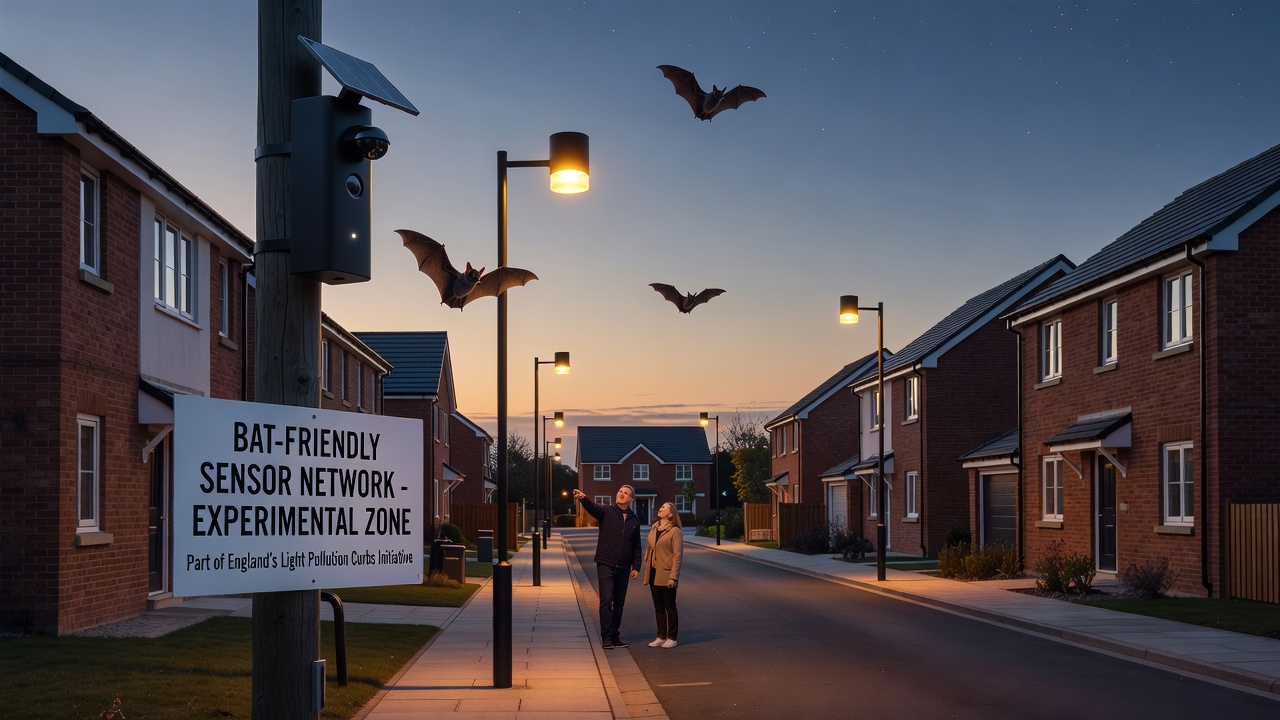
Local authorities across England have rolled out expanded controls on artificial light at night, and these measures have prompted residential neighborhoods to trial networks of motion-activated sensors that dim or redirect outdoor fixtures when bats pass through, with several pilot programs active as of October 2026. The approach combines regulatory pressure on sky glow with technology that responds to animal movement patterns recorded by ultrasonic detectors placed along hedgerows and garden edges.
Councils in counties such as Surrey and Oxfordshire began installing the first clusters of these sensors during the summer of 2025, and the systems link street lamps plus private security lights to a central dashboard that logs bat activity through frequency signatures between 20 and 200 kilohertz. When detectors register a passing pipistrelle or noctule, the network lowers brightness by up to 70 percent for intervals of 30 to 90 seconds, then returns illumination to standard levels once the animal moves beyond the monitored zone.
Regulatory Background and Measurement Standards
National guidelines updated in late 2024 set maximum sky-glow thresholds for new and existing developments, and these rules require local planning departments to document upward light spill using calibrated luminance meters placed at 1.5 meters above ground. Measurements taken in October 2026 across 12 suburban test sites showed average reductions of 18 percent in vertical illuminance compared with baseline readings from 2023, according to records maintained by the Department for Environment, Food and Rural Affairs.
Similar standards appear in documents issued by the European Environment Agency, which track comparable limits in member states bordering the English Channel, and those reports note that coordinated sensor networks have produced measurable drops in documented bat collision incidents near illuminated roadways.
Technical Components of the Sensor Networks
Each residential installation typically includes between four and twelve ultrasonic units mounted on fence posts or low poles, paired with LED luminaires that accept wireless dimming commands through a 2.4-gigahertz mesh protocol. The sensors sample ambient sound every 250 milliseconds, and onboard processors filter out insect and bird calls before triggering any lighting change. Power for the nodes comes from small solar panels supplemented by battery packs rated for 72 hours of continuous operation during overcast periods.
Installation teams have reported that retrofitting an average cul-de-sac of 25 homes requires two technicians and takes less than six hours, after which the network self-calibrates over a 14-day period by comparing bat passes against manual observations made with night-vision binoculars. Data logs stored on local gateways upload nightly summaries to a secure server hosted by the participating council, allowing planners to adjust sensitivity thresholds without physical site visits.
Observed Outcomes in Early Deployments
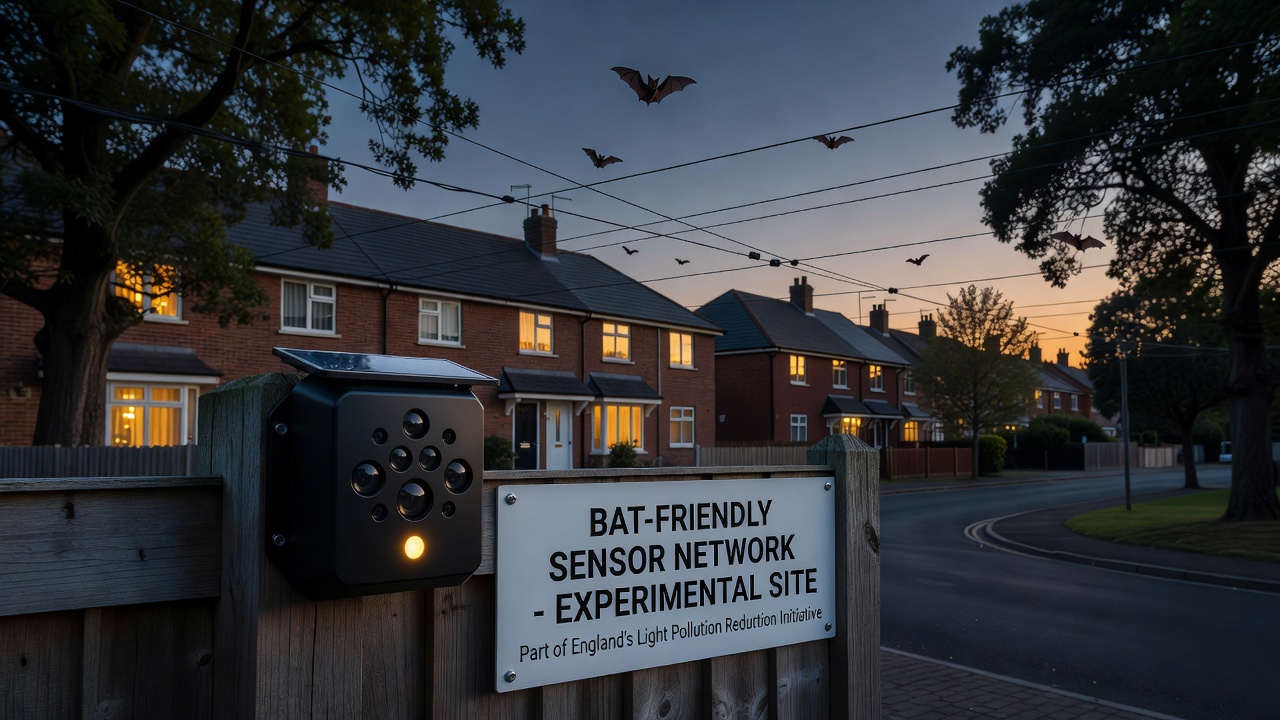
Early data collected through October 2026 indicate that bat foraging time within the sensor zones increased by an average of 22 minutes per night compared with adjacent control streets that retained fixed lighting schedules. Researchers from the University of Bristol, working in partnership with three district councils, documented these shifts through repeated transect surveys that counted feeding buzzes, which serve as acoustic markers of prey capture attempts.
Residents in the trial areas have noted that the dimming events remain brief enough that overall security perception stays intact, while the automated system eliminates the need for manual timers or motion sensors limited to human-scale detection ranges. One neighborhood association in Hampshire compiled resident feedback forms showing that 84 percent of respondents reported no change in their sense of safety after the first three months of operation.
Integration with Existing Planning Processes
Developers seeking approval for new housing estates must now submit lighting impact assessments that incorporate predicted bat flight paths derived from habitat surveys, and several authorities accept data from the sensor networks as evidence that mitigation measures meet the required thresholds. This integration has reduced the number of planning conditions that previously mandated full shielding of every exterior fitting, because the dynamic response capability addresses peak activity periods without permanent reductions in average illuminance.
Training sessions run by the Chartered Institution of Building Services Engineers have included modules on configuring these networks, and attendance figures for the October 2026 courses exceeded projections by 35 percent, reflecting growing demand from both public-sector engineers and private electrical contractors.
Future Expansion and Data Sharing
Discussions are underway to link the suburban networks with larger-scale monitoring arrays operated by the National Bat Monitoring Programme, which already maintains static detectors at over 200 sites nationwide. Shared data protocols would allow aggregation of nightly activity counts while preserving the privacy of individual household lighting patterns through anonymized identifiers. Pilot exchanges scheduled for early 2027 aim to test whether aggregated trends can inform regional conservation priorities without requiring additional hardware investment from participating councils.
Conclusion
England's combination of tighter sky-glow regulations and localized sensor technology has produced measurable changes in how residential lighting interacts with nocturnal wildlife, and continued collection of activity data through 2027 will determine whether these systems scale effectively beyond the initial suburban test zones. The approach demonstrates one practical method for balancing human safety requirements with ecological considerations in built environments.