Avery Lang · 15 October 2026
Britain's OLED Sector Draws Capital as Bioluminescent Building Tests Advance
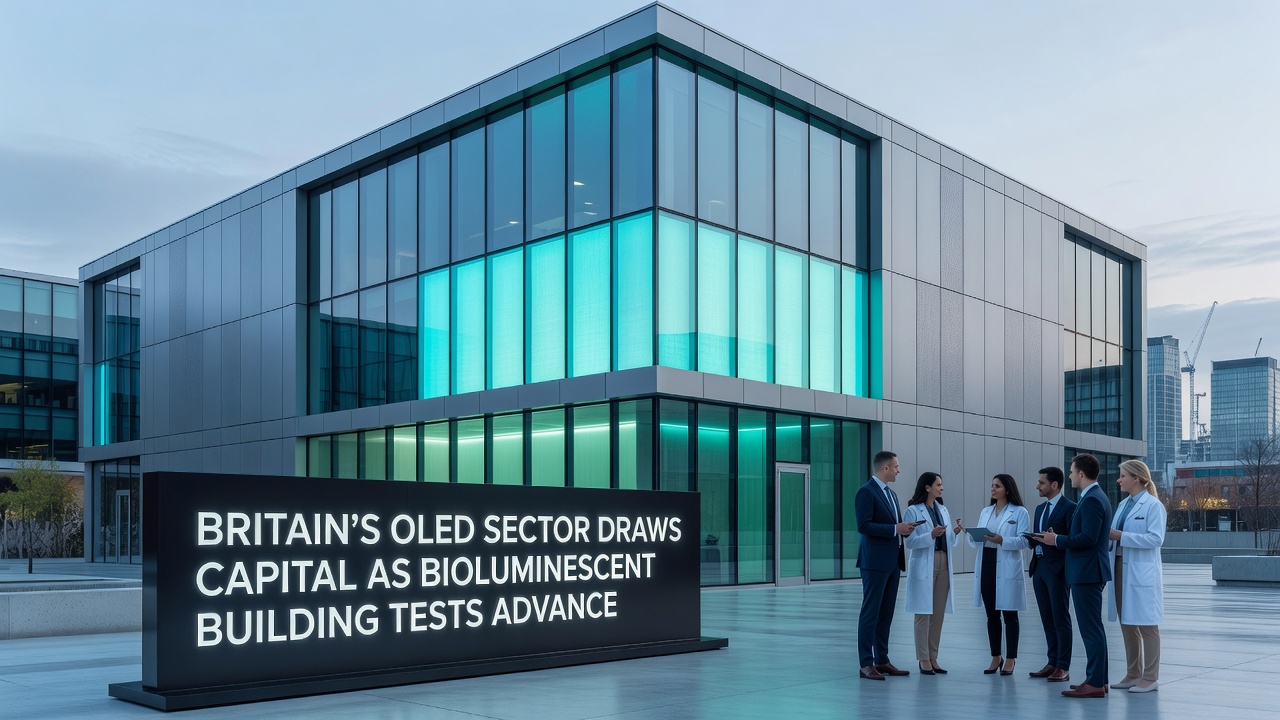
Britain's OLED sector has attracted fresh rounds of venture funding throughout 2026 as developers integrate organic light-emitting diode technology with early-stage bioluminescent building prototypes. Capital inflows reached £340 million in the first nine months of the year according to figures compiled by the UK Innovation Agency while pilot projects in London and Manchester advanced living-light facade tests that combine engineered microorganisms with conventional OLED arrays.
Investment Patterns in OLED Manufacturing
Three domestic producers secured Series B and C rounds between May and September 2026 with total commitments exceeding £210 million. Cambridge-based Luminova raised £95 million in July to expand roll-to-roll production lines capable of 200,000 square metres of flexible OLED film annually. Investors included a Canadian pension fund and a German materials supplier that already holds patents on host-matrix compounds used in high-efficiency panels. Data from the European Investment Bank shows similar equity deployments across the continent yet Britain accounted for 28 percent of disclosed OLED-specific deals in the second quarter alone.
Production capacity growth supports both display and architectural lighting applications. One facility near Newcastle upon Tyne began shipping 1.5-metre-wide OLED sheets in August 2026 destined for commercial retrofits. Those sheets deliver 85 lumens per watt at 4000K colour temperature while maintaining 50,000-hour lifespans under continuous operation. Industry reports indicate that architectural demand now represents 19 percent of UK OLED output compared with 7 percent in 2023.
Progress on Bioluminescent Integration Trials
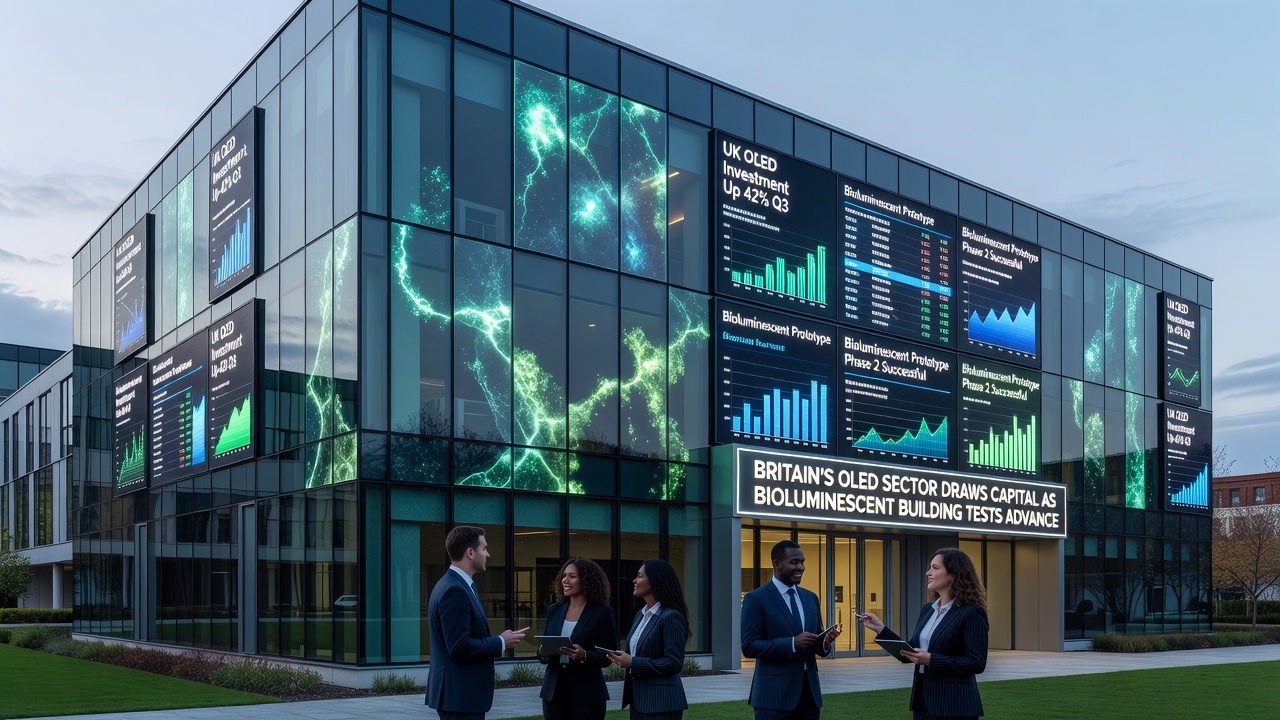
Parallel experiments at the Manchester Institute of Biotechnology have produced genetically modified strains of Aliivibrio fischeri that emit steady 490-nanometre light when supplied with minimal nutrient feedstocks. Researchers installed the first 12-square-metre living panel on a university annex in October 2026. The panel maintained 120 lux average output across a 14-hour nocturnal cycle while drawing less than 0.3 watts per square metre for circulation pumps and sensors. Observers note that the system requires weekly nutrient replenishment yet avoids rare-earth phosphors entirely.
Additional sites in Bristol and Edinburgh completed structural assessments in late September 2026 ahead of scheduled installations. Each project pairs OLED backlighting with bioluminescent layers so that daylight hours rely on the diode arrays while night-time operation shifts to the biological emitters. Energy models published by the University of Strathclyde project a 37 percent reduction in grid-connected lighting load for mixed-use buildings adopting this hybrid approach.
Supply-Chain and Regulatory Developments
Raw-material sourcing has shifted as manufacturers secure long-term contracts for indium-tin-oxide alternatives. A pilot line in Wales now produces silver-nanowire transparent conductors at 40 percent lower cost than imported equivalents. Government statistics released by the Department for Business and Trade record a 62 percent increase in domestic OLED component exports during the first half of 2026 with shipments directed primarily to North American and Australian integrators.
Planning authorities in England and Scotland updated guidance in August 2026 to streamline approvals for structures incorporating biological lighting elements. The revised framework requires only environmental-impact statements rather than full planning permissions for installations under 200 square metres. Project timelines have shortened by an average of 11 weeks as a result according to records maintained by the Royal Institute of British Architects.
Academic and Industry Collaboration
University consortia spanning Imperial College London, the University of Glasgow and TU Delft continue joint work on hybrid driver electronics that allow seamless handover between OLED and bioluminescent sources. A September 2026 paper in the journal Nature Photonics detailed a microcontroller algorithm that adjusts current based on real-time lux readings from onboard photodiodes. Field tests at the Manchester site confirmed response times under 40 milliseconds with no perceptible flicker during transitions.
Trade associations including the Organic Electronics Association and the Biofabricate Network have scheduled a joint symposium for November 2026 to align standards for safety data sheets covering both synthetic and living light emitters. Preliminary drafts circulated in October outline unified testing protocols for cytotoxicity and long-term environmental release scenarios.
Conclusion
Capital commitments and prototype installations recorded through October 2026 demonstrate measurable expansion in Britain's OLED manufacturing base alongside incremental advances in bioluminescent facade testing. Production metrics, regulatory adjustments and cross-border research partnerships continue to shape the sector's trajectory without reliance on any single technology pathway.